Memory connection
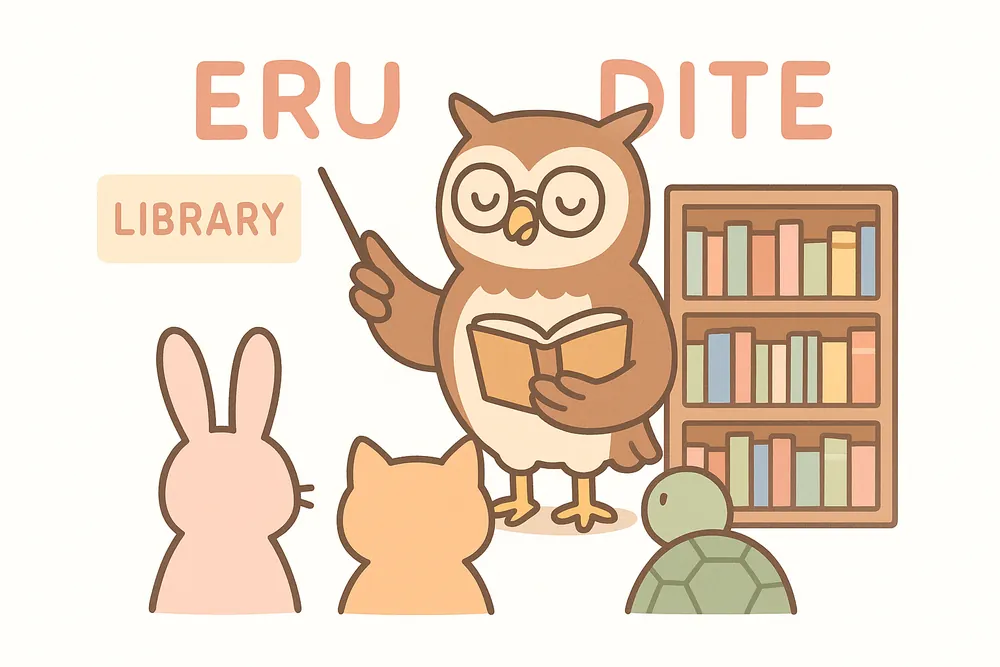
Picture “airy, you cite”
An owl floats through an airy library and cites a different book for every answer, displaying immense learning.
The sound cue helps you reach the scene; the action in the scene carries you from the scene to the definition.
Use it accurately
Meaning in context
The lecturer was erudite without making beginners feel unwelcome.
Her essay is an erudite examination of trade along the ancient coast.
Erudite describes deep learning acquired through study, or writing and conversation that display such learning. It is more specific than intelligent.
Common patterns
- an erudite scholar
- erudite discussion
- both witty and erudite
Go deeper
Build a more precise understanding
Where the word comes from
Erudite comes from Latin erudire, literally “to bring out of roughness.” The verb combined ex-, “out,” with rudis, “rough or untrained,” to picture education as a process of refinement.
Register and usage
This approving, formal adjective suggests deep scholarly learning rather than ordinary competence. It can describe a person, discussion, or work, although an erudite style may also feel demanding to a general reader.
Word family
- erudition (noun)
- eruditely (adverb)
References for further checking
These links provide fuller dictionary and word-history entries. MnemoWords writes its own learner explanation rather than reproducing their definitions.
Quick check
Can you retrieve the meaning?
What would make a history lecture erudite?
Choose an answer, then explain it in your own words.